

Releasing Emotions: A Key to Healing


Emotions are meant to come up, be experienced fully, and pass.
When a pleasant emotion arises, we are usually willing to feel it. But even then, some of us hold back. We fear that opening our hearts to deep love or joy simply leaves us vulnerable to the pain of its eventual loss.
Yet for most of us, the real challenge is dealing with painful emotions. Experiencing painful emotions is a natural, unavoidable part of being human. While the pain is unavoidable, suffering is not.
Emotional pain becomes suffering
To understand how our responses create suffering, let’s look at two different paths.
Tracy’s husband died suddenly five years ago. Today, she describes herself as an “emotional wreck.” She experiences regular crying episodes, cannot bring herself to enter their shared bedroom, and feels unable to lead a normal life. Tracy’s grief (pain) is natural, but her inability to function years later indicates that her pain has turned into suffering.
Juan’s wife left him five years ago. In response, he closed his heart. Today, his friends notice his affect is flat. He hasn’t been able to have a serious relationship since. His inability to connect deeply is a function of his commitment to never be hurt like that again.
Though their reactions were different, Tracy and Juan share a striking commonality: both have far less energy today than they did five years ago. Both are suffering.
But can we avoid suffering? Below we will discuss how to do so.
Everyday Triggers and Big Reactions
You don’t need a massive tragedy to see the following dynamic at play. Consider these common scenarios:
Marco is watching TV. His wife walks in and says, “I thought you were going to take out the garbage.” Marco snaps angrily: “I’ll do it. Get off my back!”
Kim has waited all day for her daughter to call to wish her happy birthday. By evening, she is distraught because her daughter hasn’t called. Her birthday is ruined and she is in pain.
Belle wears new blouse and, at dinner, asks her wife, Sara, if she likes it. Sara casually replies, “It’s alright.” Belle is so deeply hurt she can’t enjoy her meal.
What do these everyday examples have in common? The reaction is disproportionate to the trigger. A minor event has hit a nerve.
The Anatomy of an “Energy Block”
When we don’t consciously complete an emotion, we are left with unfinished business. We call this unprocessed emotion an “energy block.”
Think of your life force—your qi, shakti, or prana—like a vibrant, flowing stream. An energy block interferes with that flow in three distinct ways:
Obstruction: It acts like a large rock dropped into a stream, partially impeding the normal flow of energy.
Energy Drain: It ties up energy. It requires constant energy to hold that unfinished emotion away from your awareness.
Vulnerability: As long as the block remains, the core emotion can be instantly reignited by life events or passing thoughts.
Related to this third point, there isn’t some cosmic entity trying to trigger your blocks. It’s purely mechanical.
Imagine you have a sore finger. Life will inevitably bump into it. Someone squeezes your hand in a greeting, you catch it while getting dressed, or you pick up a grocery bag. The finger isn’t being targeted; it’s just vulnerable.
Consider the following. Paul calls his wife to say he’s having a last-minute dinner with an old friend. His wife gets sullen and anxious. Bernie makes a similar call and his spouse cheerfully says, “Have a great time!” What is the difference? In the case of Paul’s wife an energy block was hit. For Bernie’s wife, nothing was triggered.
Our emotional reactions are generally not caused by the events in our lives. The blocks getting hit cause the reactions.
Suppressing and Expressing
Most of us only learned two ways to handle uncomfortable emotions: suppressing them or expressing them. Unfortunately, both options only make the rock in the stream bigger.
1. Suppressing (The “Stuff It” Method)
This is denial. We talk ourselves out of our feelings (“It’s no big deal”), distract ourselves with work, or self-medicate with alcohol, food, or screens. Even well-meaning loved ones encourage this when they tell a grieving friend to “keep busy” or “immerse yourself in work.” While it may seem to work for a few minutes, it only grows the underlying block.
2. Expressing (The “Dump It” Method)
This is yelling when we are angry or pounding our fists in frustration. We might feel a momentary sense of relief, like we “got it out,” but we do nothing to dissolve the block. In fact, it reinforces the loop, making future explosions more frequent and likely more intense.
The Third Way: Releasing
Rather than stuffing or dumping the energy, we can release it. Releasing is the process of consciously allowing an emotion to complete and pass.
This is a natural healing process. Just as a cut on your arm heals if you stop picking at it, your energetic blocks will dissolve if you stop interfering with the releasing process.
Here is a four-step somatic (body-based) practice for emotional release, adapted from the insights of Michael A. (Mickey) Singer. It not only completes the emotion of the moment but also eliminates or diminishes the energy block that was triggered.
1. Open and Relax
The moment you feel an uncomfortable emotion, sit up straight or lie on your back. Open your chest and relax your body. For intense emotions, opening your chest is the exact opposite of your instinct, which is to curl into a protective fetal position. Opening up physically signals to your system that you are ready to let the energy move without interference.
2. Witness the Body Sensation
Focus your attention on the physical sensations in your body. Do you feel a churning in your belly? An ache in your heart? A tightness in your jaw? Watch the feeling as it continues and changes. You do not need to label the emotion, and you do not need to analyze its origin. If your mind starts spinning a story (“How dare they say that to me!”), gently let the thought go and return to the physical sensation.
3. Bring in Sincere Gratitude
(This and #4 are additions I have made to the process based on my experience.)
It is easy to quietly resist an uncomfortable feeling even while trying to observe it without interfering. To preempt this subtle resistance, consciously welcome the experience. Acknowledge that this discomfort is an opportunity for real healing. Sincerely expressing gratitude for the chance to dissolve a lifelong block is incompatible with resistance to the feeling.
4. Welcome the Intensity
Ask for the full intensity. Just like a deep tissue massage, when the therapist hits a painful knot in your shoulder, you don’t pull away—you breathe into it and say, “Yes, right there,” because you know the pressure is what breaks up the tension. Welcome the full strength of the emotional energy, knowing that the greater the intensity, the more of the block it can take away.
The 30-Second Trap: The most common beginners’ misconception is displayed in the statement, “I’ve been watching this feeling for thirty seconds and it’s still here!” Remember, this isn’t a way to make the pain go away. Expecting the feeling to vanish quickly is a form of resistance. Give the healing the time it needs.
The Open Heart
When we release our emotions, we emerge from the process more open. When we suppress or express them, we leave ourselves more closed. I experienced this contrast firsthand after two different romantic breakups. After the first one, before I knew anything about releasing, I struggled and suffered for months. Years later, a subsequent relationship ended in a very similar way. This time, I committed fully to the practice of releasing. I sat with the acute pain, welcomed the energy, and let it pass through me.
The recovery was remarkably fast, but the real surprise came later. Several friends and colleagues independently approached me and noted that I seemed “softer” and “more open.” I could feel it myself. I was capable of being more vulnerable because I had fewer blocks to defend.
From Feeling an Emotion to Witnessing It
When I share this practice, I often get a variation of the same question, “I am completely feeling my grief. I am sad and crying. How is that different from releasing?”
The questioner is immersed in grief. She is identified with it. Releasing an emotion requires you to stop being the emotion and start witnessing it–consciously observing it.
When you shift your focus entirely to the physical sensations in your body, the external “story,” the “cause” and the blame fade into the background. You are observing an internal process. Your mind will try to drag you back into the narrative (“How could this happen? It’s not fair!”), but every time you catch it doing so, you simply return your attention to the body.
Through this shift, you realize a profound truth: You are not the emotion. The emotion is merely an object passing through your consciousness.
Pain vs. Suffering: My Personal Turning Point
Before I learned how to release, when I went through an emotionally devastating event like losing a loved one, the grief felt like a bleak, unyielding cloud. I would try to push through it—do some work, watch some TV—but it hovered over me constantly. I was fundamentally not okay. I was suffering.
Once I started practicing releasing, the nature of my experience changed. When a wave of grief hit, the pain was just as intense—sometimes even sharper—but I stopped suffering.
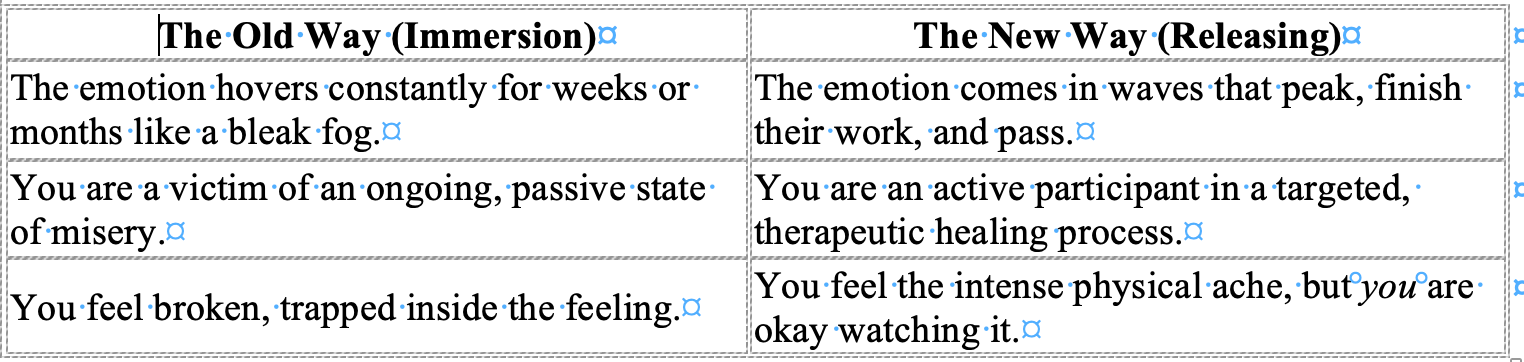
Grief and other powerful emotions do not actually stay switched on 24/7. They come in waves. If you stop and fully release each wave as it arrives, the pain becomes limited in duration, deeply beneficial, and it leaves you less obstructed on the other side.
Leaning Into the Trigger
In doing this work I realized: If there is something inside that can be triggered, I want it out.
Let’s look back at Tracy, who avoided her shared bedroom and couldn’t bear to go through her late husband’s clothes because “it makes it too real and it’s too painful.”
Her choices are completely understandable. Most people do exactly the same thing. But avoiding those triggers actually preserves the energy block.
If we are sincerely committed to emotional freedom, we stop running from our triggers. We start using them.
Every single item Tracy avoided—the clothes, the bedroom, the paperwork—held the exact emotional current she needed to feel in order to heal. Moving toward those triggering elements allows the energy to surface so it can finally be released.
This applies to minor things, too. If you have an awkward, stressful interaction with a neighbor, do you deliberately alter your route to the supermarket to avoid running into them? Or do you walk your normal route, welcoming whatever uncomfortable feelings bubble up so you can clear them?
(To be clear: this isn’t about timing. I am not suggesting someone clear out a late spouse’s closet days after a funeral. It’s about a shift in perspective—moving from seeing a trigger as something to be avoided as long as possible to seeing it as an initiator of healing.)
Overcoming Fear of Our Emotions
It is important to remember that releasing is a purely internal process. It doesn’t mean you become passive. Once you’ve sat with the physical energy and let it clear, you might still need to have a tough conversation with the person who triggered you.
But there is a world of difference between speaking from a reactive, defensive position and speaking from a centered, fully present space. Your conversations become cleaner, more self-responsible, and more loving.
But the absolute best part of this practice? You stop being afraid of your own feelings.
Think about it: every single event we fear in this life, we fear because of how we think it will make us feel. We spend an immense amount of daily energy organizing our lives, our careers, and our relationships just to avoid uncomfortable emotional states.
How liberating would it be to drop that fear?
When you begin to realize that you can sit through any emotional storm, observe the physical sensations, and come out whole on the other side, fear loses its grip.
But don’t take my word for it. Experiment with this process, and find what is true for you.
Please restack so others may benefit
Please share this link on your social media.
thank you marty. this is lovely. how do you feel with this type of practice with physical pain or illness? i tried something much like this last night and it was lovely and supportive experience.
This piece is beautiful! These 2 sentences really stuck with me: 1. "Releasing an emotion requires you to stop being the emotion and start witnessing it–consciously observing it."
2. If we are sincerely committed to emotional freedom, we stop running from our triggers. We start using them."
I wish to share from my own experiences that releasing emotions do become much easier when we can see that we are not our emotions or the mind. We have them (Emotions and Mind) and they are our tools to use but they should never define or dictate our lives and decision making process, we should be the ones to consciously use them!
When we decide to stop running from our triggers and start to consciously use them, we end the karmic cycle because we are now using them as an opportunity for liberation.
Sometimes easier said then done however if we stick to the process the mind and our awareness will continue to become very sharp.
P.S. I love Mickey Singer! Have you ever been to Temple of the Universe here in Gainesville? He gives talks a few days a week in the evenings.