The Non-Solution Solution: Using the Mind to Counter the Mind

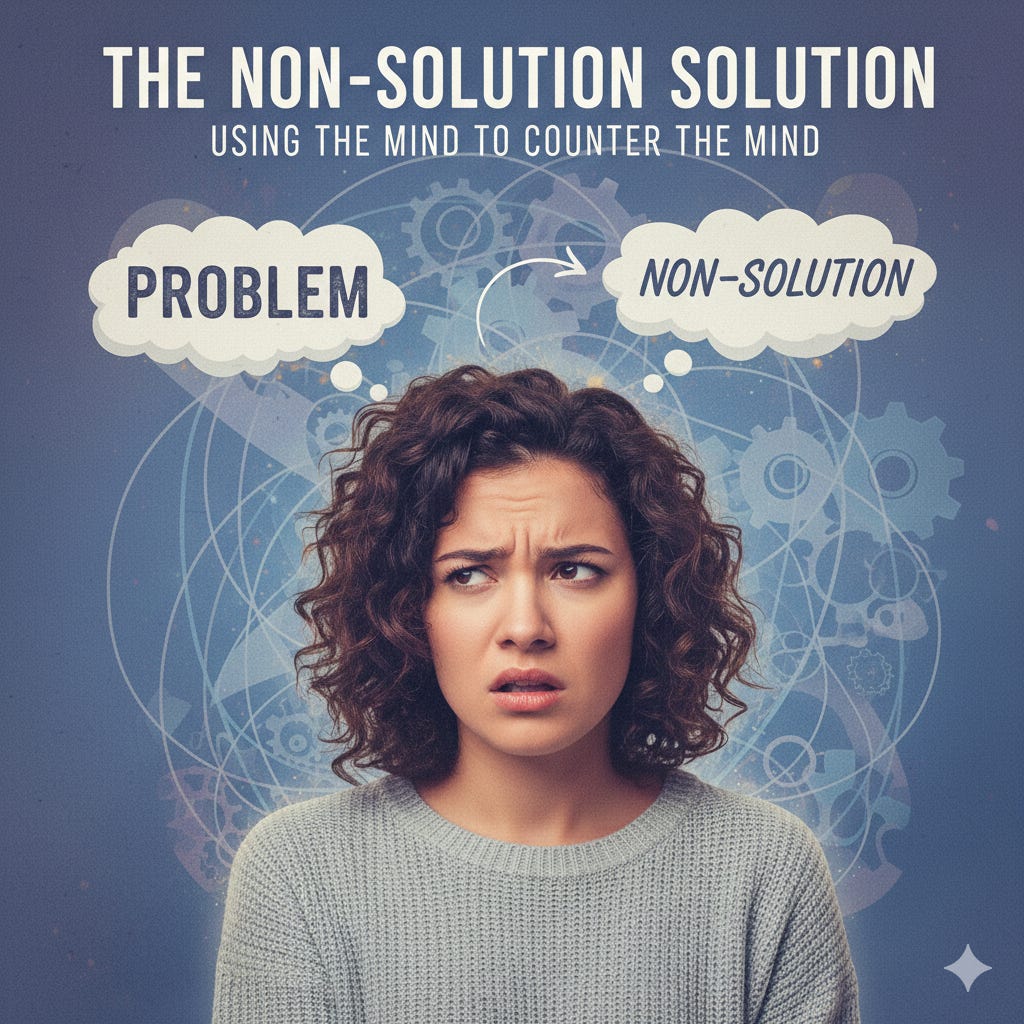
One of the most significant milestones in our spiritual development is the moment we realize our mind is a problem-generating machine. It bombards us with messages that aren’t just unhelpful—they are the primary cause of our suffering.
The Illusion of Problem-Solving
Imagine you have a medical test scheduled for two days from now. Almost instantly, the mind begins its monologue: What if it’s cancer? What if it’s serious? Suddenly, you are disturbed. If you’ve done even a little spiritual work, you might recognize that your distress isn’t actually coming from the medical test itself. It’s coming from your mind’s commentary about the test.
This awareness is a vital first step. But this is where most of us get stuck. Our knee-jerk reaction is to use the mind to “correct” or “improve” the mind. We try to counter a negative thought with a “better” one.
Using the Mind to Counter the Mind
When we feel anxious about the test, we might go to Google to find statistics. We tell ourselves, “There’s only a 15% chance this is serious.” Or we give ourselves stern advice: “Don’t worry. Nothing’s happened yet. Just focus on your work or go read a book.”
We think we are solving the problem, but the mind cannot solve mind-made problems. Let’ examine this claim.
The Mind-Made Problem and Non-Solution
The mind creates these problems in its attempt to take care of us the only way it knows how: by trying to control our future life experiences.
If the mind can’t control the actual outcome of the test, it attempts to minimize the potential shock or disappointment by forcing us to deal with the worst-case scenario in advance. Unfortunately, this causes us to suffer, even if the test ultimately shows that nothing is wrong.
The mind is focused on controlling our future life. This is the source of our stress, worry, and fear. When we use the mind to “fix” our anxiety, it is simply trying to control the future experience of the problem it just created.
It cannot work.
How to Make Real Change
True transformation doesn’t happen by changing the content of your thoughts; it happens by changing your relationship to them. To do this, we have two primary tools:
1. Witnessing the Mind
Imagine you are watching a movie on television. The content on the screen can be sad, happy, or scary. But it is not a problem for you because you are the observer.
The Shift: As soon as you witness a thought, you are no longer identified with it.
The Result: You don’t have to believe the content. The mind is no longer in charge; thoughts are just something you are watching pass by.
2. Completing the Emotional Content
Disturbances happen because a thought “pushes a button.” But a button can only be pushed if it already exists within you. Instead of trying to think your way out of the tightness in your chest or the knot in your stomach, try this:
Relax the body: Open your chest and soften your shoulders.
Observe the physical sensation: Watch the tightness. Feel the altered breathing.
Allow it to finish: Don’t try to “get rid” of the feeling. Sit with it until the energy completes its cycle.
(For a detailed description of releasing emotions, see this guide.)
Moving Beyond the Illusion
When we stop identifying with the mind and start allowing our emotional disturbances to complete themselves, we move from the illusion of change to real change. The mind isn’t the problem. The thoughts aren’t the problem. It is our relationship to them that determines our peace.
Putting this into action: The next time you catch your mind creating disturbance, don’t try to talk yourself out of it. Use the two tools described above. Like any skill, it gets better and easier with practice.