

Spiritual Bypassing
A Simple Explanation of a Subtle Trap

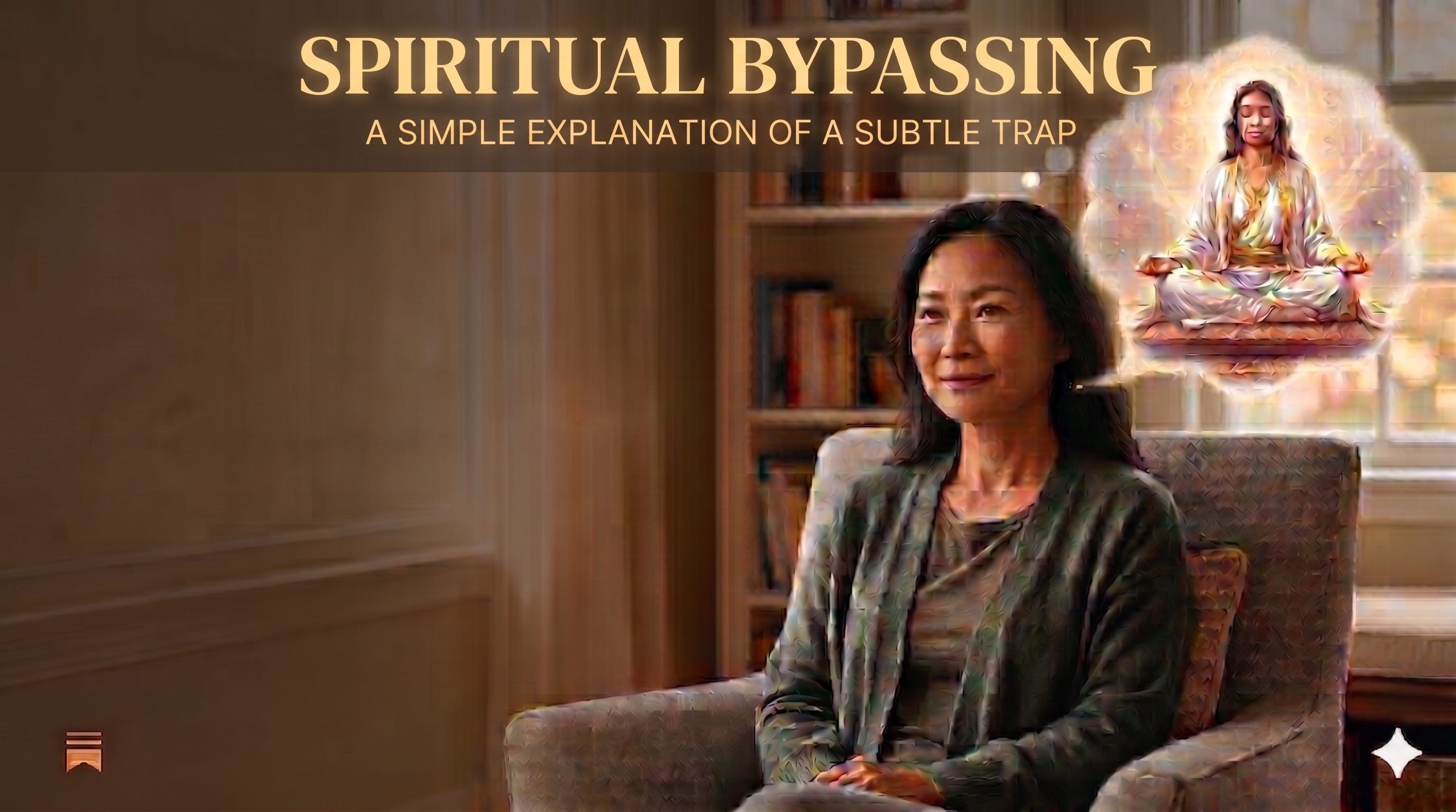
If you have spent any time reading or skimming posts related to spirituality on Substack lately, you have probably noticed a specific phrase popping up with increasing frequency: “spiritual bypassing.” The term touches upon some of the subtle traps that await us along the spiritual path.
Spirituality as a Change in Paradigm
To discuss spiritual bypassing, I first identify, what is for me, the core of spiritual development, a change in the principal paradigm guiding our lives. Most people live in what we might call the “common paradigm.”
The Common Paradigm
Briefly, the common paradigm involves identification with the ego mind and the self-concept it creates.
The ego mind is the aspect of the mind that tries to take care of us. (See Our Problem With the Ego Mind and The Well-Intentioned but Incompetent Ego Mind.) It is constantly, based on its “learning” from the past,” telling us what we need and what we need to avoid in order to be okay or happy in the future. We tend to listen to its dictates and believe them. The result is that we are never okay now. We are busy trying to get life to conform to the ego mind’s preferences, a job that is stressful and impossible to accomplish.
The ego mind also finds ways for us to try to avoid feeling painful or uncomfortable emotions. (See Releasing Emotions.) The result is an ongoing energy drain and a tendency to overreact to subsequent triggers (See The Biggest Drain on Our Energy is Self-Inflicted.)
The self-concept is a false self, created by the ego mind, consisting of your roles, history, beliefs, strengths and weaknesses. (See The Self-Concept Trap.) It is one of the tools the ego mind uses in its attempts to control how others respond to you.
The Spiritual Paradigm
The spiritual paradigm is very simple. However, the shift from the common paradigm can be challenging and is not a one-time event. The spiritual paradigm involves letting go of identification with the ego-mind and the self-concept. It is achieved by witnessing the mind.
When we witness the mind, we realize we are neither the mind nor the self-concept. We are the witness, the consciousness.
As a result, we no longer believe in the dictates of the ego mind. We are okay now, not sometime in the future when life conforms to our preferences.
We witness our emotions, releasing both the current reaction and the unfinished business that was triggered.
And we let go of our self-concept, fully embracing our real self.
What is Spiritual Bypassing?
Spiritual bypassing is the adaptation of the ego-mind to stay in control as a person is increasingly living in the spiritual paradigm.
Although one may be living more and more in the spiritual paradigm, the ego mind continues to operate according to its nature. It realizes that the landscape has changed. Many of its prior demands are no longer being accepted.
In the past, it might have said, “I will be happy when I get a new convertible,” or “I will be happy when I get into a new relationship.” As you grow spiritually, you stop buying into those types of claims.
So, the ego mind adapts. It begins speaking “spiritual.” Now, it says things like, “I will be happy when I meditate for an hour a day,” or “I will be okay when I eat a clean diet.”
It is the same egoic principle—I will be happy in the future, contingent upon an external achievement—but it sounds spiritual.
The bypassing also manifests in how we handle uncomfortable emotions like anger, grief, or fear.
Imagine you begin to feel a surge of genuine anger. Suddenly, the ego-mind steps in and whispers: “I don’t get angry anymore. I am peaceful now. I am too evolved to get angry at such trivial matters.”
This is the ultimate bypass. It is the refusal to experience the anger, choosing instead to hide behind a fabricated, high-vibe identity to avoid pain. The ego builds a brand-new self-concept steeped in spiritual ideals:
“I am peaceful.”
“I am loving.”
“I am completely unattached to material things.”
This new identity seems to fit. But it is a trap. It is the old egoic patterns operating a little more subtly, potentially yielding the same results.
Authentic spirituality is not about trading a non-spiritual identity for a spiritual one. It is not about exchanging worldly concepts for spiritual concepts. It is about letting go of our concepts and our false identities altogether.
Every time we meet the present moment with a rigid concept, we are no longer present. We are no longer seeing reality as it actually is; we are looking at it through a screen. And looking at life through a screen of spiritual concepts is not an improvement.
Planting the Seed
My teacher, Yogi Amrit Desai, often says, “If you want a mango tree, you have to plant a mango seed.”
Whatever you want to experience in the future, you have to embody now and in each moment. Most people spend fifty years practicing stress, anxiety, and inner conflict, hoping that when they finally retire, they will somehow harvest happiness. It simply doesn’t work that way. You may retire wealthy, but probably not happy, healthy, and peaceful. We create what we practice. The seed we plant and nourish determines the fruit we harvest.
Entering the Experiment
To be clear, this does not mean the mind is your enemy, nor does it mean you cannot use it as a tool. It may give you valuable advice about what to eat, how to invest, or how to take care of your home.
The problem arises when we let the ego mind dictate our worth, telling us we will only be okay when the diet is perfect, when the investments make us rich, or when our home is problem-free.
True spiritual exploration is an experiment. It requires us to sit, witness the thoughts as they come and go, and realize they are not inherently ours. They arise from a limited part of the mind that tries to protect us but ultimately causes suffering.
If we want peace, love, and joy, we have to continue letting go. The ego mind’s messages may be different. The concepts and self-concept may appear more spiritual. But we must still witness the ego mind. We must continue to return to the present moment–seeing it as it is.
Please restack so others may benefit
Please share this link on your social media.
The simplest diagnostic is in the language. Count how many times "I" appears in a thought, a claim, a spiritual statement. "I am peaceful." "I am witnessing." "I am the consciousness." The content has changed. The speaker hasn't. The ego is still organizing around an identity — it's just wearing different clothes. Where the "I" disappears, something else becomes possible.
A controversial thought: If everything is an illusion, does it ultimately matter whether a rock is a rock, spiritually bypassed, or self-realized?
Whatever works.
Unless someone is carrying a deep existential angst and attempting to resolve the disconnect with their true Self, let the rest play with their toys.
It gives them something to do in the theater of the mind.
— The Marketplace Mystic
http://buddhaontherollercoaster.substack.com